
- Home
- About Doctor
- Cancer Surgery
- Procedures & Techniques
- Minimally Invasive Cancer Surgery
- Robotic Cancer Surgery
- Laparoscopic Cancer Surgery
- Thoracoscopic Cancer Surgery (VATS)
- Open (Conventional) Cancer Surgery
- Sentinel Lymph Node Biopsy (SLNB)
- Cytoreductive Surgery (CRS)
- Hyperthermic Intraperitoneal Chemotherapy (HIPEC)
- Scarless/ Remote Access Thyroidectomy
- Resources
- Contact Us
Parathyroid Tumors
Message from Dr. Ajay Simha

Being diagnosed with a parathyroid disorder can create uncertainty for patients and their families. Understanding the condition, available treatment options, expected outcomes, and the need for surgery can help patients make informed decisions about their healthcare.
When a parathyroid tumour or hyperparathyroidism is suspected or diagnosed, a detailed evaluation is carried out to assess calcium levels, parathyroid hormone (PTH) levels, tumour characteristics, imaging findings, hormonal activity, symptoms, and the patient’s overall health. A personalised treatment plan is then formulated based on the underlying condition and individual patient requirements.
I am Dr. Ajay Simha, Consultant Surgical Oncologist (Cancer Surgeon), providing parathyroid tumour and hyperparathyroidism surgical care at Manipal Hospitals Sarjapur Road, Bengaluru. This page provides an overview of parathyroid tumours and hyperparathyroidism, from their symptoms and evaluation to the available treatment options.
What Is Parathyroid Tumors?

Parathyroid tumours are abnormal growths that develop in the parathyroid glands, four small glands located behind the thyroid gland in the neck. The parathyroid glands play an important role in maintaining calcium balance in the body by regulating parathyroid hormone (PTH) production.
Symptoms of Hyperparathyroidism
Symptoms of hyperparathyroidism may vary depending on calcium levels and the duration of the condition.
Common symptoms may include:
- Bone pain or weakness
- Kidney stones
- Increased thirst and frequent urination
- Fatigue and tiredness
- Muscle weakness
- Abdominal discomfort
- Constipation
- Mood changes
- Difficulty concentrating
- Increased risk of bone fractures
Some patients may have mild symptoms or may be diagnosed through routine blood investigations showing elevated calcium or PTH levels.
Evaluation of Parathyroid Tumors
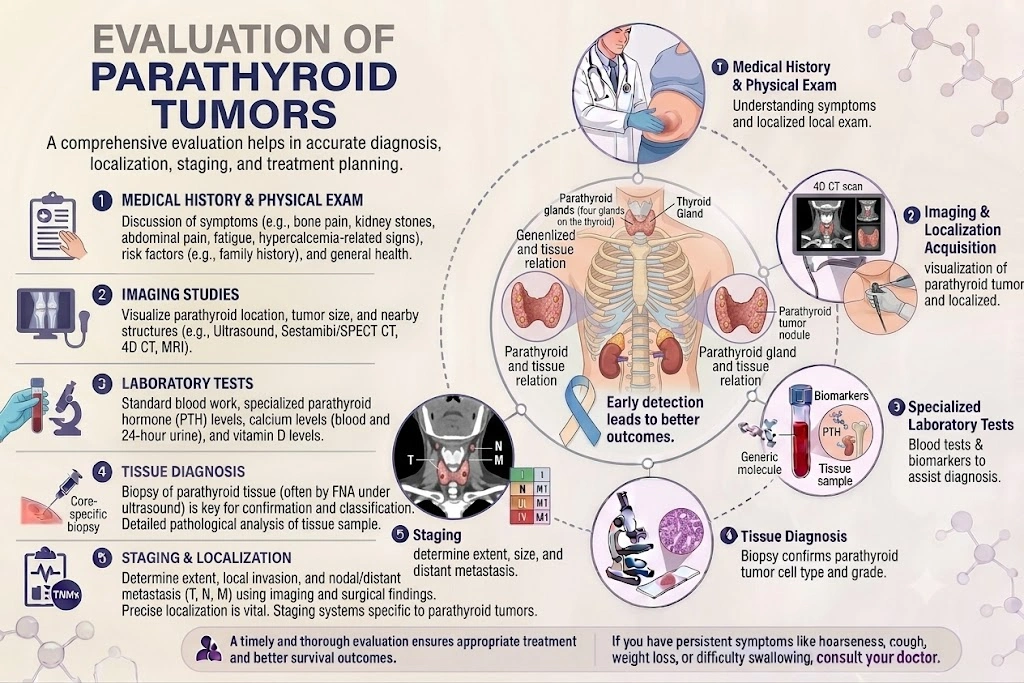
When a parathyroid tumour or hyperparathyroidism is suspected, accurate diagnosis helps identify the abnormal parathyroid gland and determine the most suitable treatment approach.
Blood Tests
Blood investigations help assess:
- Calcium levels
- Parathyroid hormone (PTH) levels
- Vitamin D levels
- Kidney function
These investigations help evaluate the severity of hormone imbalance and its effects on the body.
Ultrasound Examination
Neck ultrasound helps identify enlarged or abnormal parathyroid glands and provides information about their location.
Sestamibi Scan
A nuclear medicine scan may be used to identify the overactive parathyroid gland and assist in surgical planning.
Treatment Options for Parathyroid Tumors
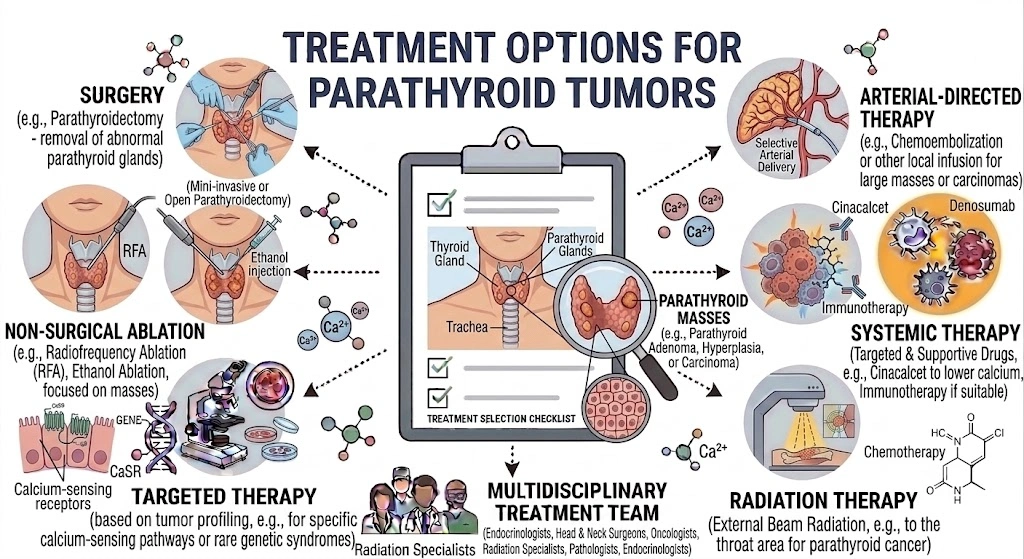
Treatment depends on several factors, including:
- Severity of symptoms
- Calcium levels
- PTH levels
- Tumour size
- Bone and kidney involvement
- Patient’s overall health condition
For patients with symptomatic hyperparathyroidism or confirmed parathyroid tumours, surgery is often the definitive treatment option. The appropriate treatment is selected based on the underlying cause, severity of hormone imbalance, tumour characteristics, and individual patient requirements.
Surgery
Parathyroid surgery, also known as parathyroidectomy, involves removing the abnormal parathyroid gland responsible for excessive hormone production.
The goal of surgery is to:
- Remove the overactive parathyroid tissue
- Restore normal calcium balance
- Reduce symptoms
- Prevent long-term complications
Radiotherapy
Radiotherapy is not routinely used for most benign parathyroid disorders. It may be considered in selected situations involving parathyroid cancer based on the extent of disease and the overall treatment plan.
Chemotherapy
Chemotherapy is not a standard treatment for most parathyroid tumours or hyperparathyroidism. In selected cases of advanced parathyroid cancer, systemic treatment may be considered based on the extent and characteristics of the disease.
Immunotherapy
Immunotherapy is not routinely used for hyperparathyroidism or most parathyroid tumours. Its role, if considered, depends on the individual characteristics and extent of advanced parathyroid cancer.
Targeted Therapy
Targeted therapy may be considered in selected cases of advanced parathyroid cancer depending on the tumour characteristics and overall treatment plan.
Supportive Care

Supportive care is an important part of managing parathyroid disorders and focuses on maintaining the patient’s nutritional status, physical well-being, recovery, and overall quality of life.
Nutritional Support
Appropriate nutrition and nutritional guidance may support overall health during treatment and recovery. Individualised advice may be provided based on calcium balance, vitamin D levels, kidney function, and the patient’s overall condition.
Physiotherapy
Physiotherapy may help patients maintain physical function and return to their previous activities of daily living, particularly when symptoms such as muscle weakness or reduced physical activity have affected mobility and strength.
Surgical Approaches for Parathyroid Tumors
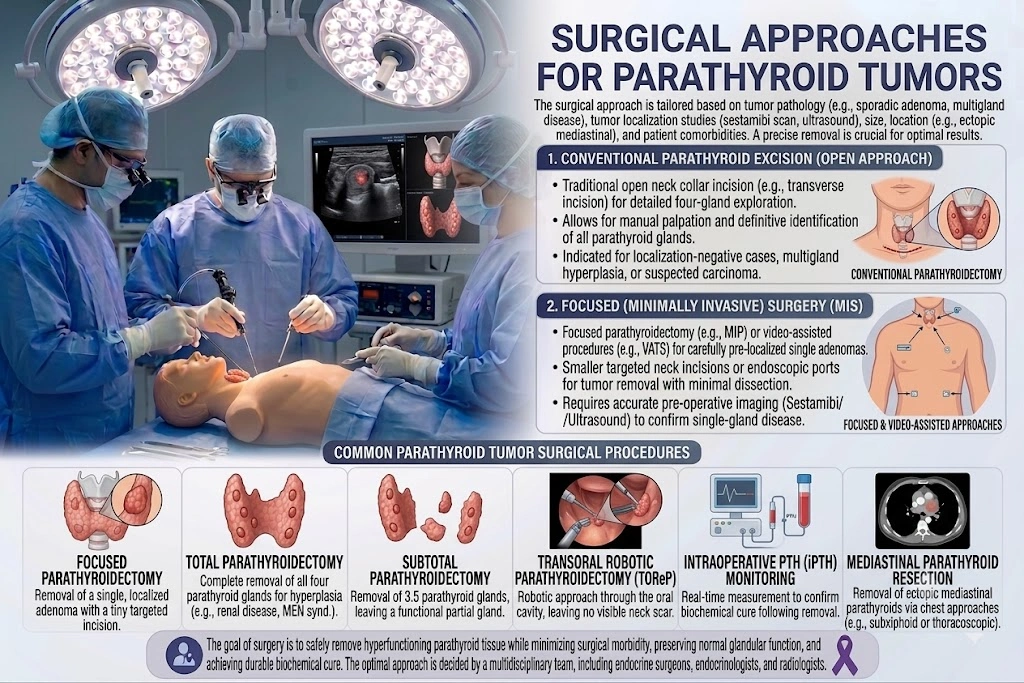
The surgical approach is selected after detailed evaluation of the number of affected glands, location of the abnormal gland, severity of hormone imbalance, previous neck surgeries, imaging findings, and the patient’s overall health.
Surgery for Multiple Parathyroid Gland Disorders
Some patients may have overactivity involving more than one parathyroid gland.
Surgical management may include:
- Removal of multiple enlarged glands
- Partial removal of parathyroid tissue when required
- Preservation of sufficient healthy parathyroid tissue
The surgical plan depends on the underlying cause, severity of hormone imbalance, and overall patient condition.
Surgery for Parathyroid Cancer
Parathyroid cancer is a rare condition that requires specialised surgical planning.
Treatment may involve:
- Removal of the affected parathyroid gland
- Removal of surrounding involved tissues when required
- Careful evaluation of nearby neck structures
Treatment decisions depend on tumour extent, disease stage, and individual patient factors.
Dr. Ajay Simha is experienced in the surgical management of parathyroid tumours and hyperparathyroidism, including focused parathyroid surgery, minimally invasive parathyroidectomy, bilateral neck exploration, and surgery for multiple-gland disorders and selected parathyroid cancers.
Frequently Asked Questions
Parathyroid tumors are abnormal growths that develop in the parathyroid glands and may affect hormone production.
Hyperparathyroidism is a condition where the parathyroid glands produce excessive parathyroid hormone, affecting calcium balance.
Symptoms may include fatigue, bone pain, kidney stones, muscle weakness, and increased thirst or urination.
Diagnosis involves blood tests, calcium and PTH measurement, ultrasound, and other imaging studies.
Surgery may be recommended for patients with symptomatic disease, high calcium levels, or confirmed parathyroid tumors.