
- Home
- About Doctor
- Cancer Surgery
- Procedures & Techniques
- Minimally Invasive Cancer Surgery
- Robotic Cancer Surgery
- Laparoscopic Cancer Surgery
- Thoracoscopic Cancer Surgery (VATS)
- Open (Conventional) Cancer Surgery
- Sentinel Lymph Node Biopsy (SLNB)
- Cytoreductive Surgery (CRS)
- Hyperthermic Intraperitoneal Chemotherapy (HIPEC)
- Scarless/ Remote Access Thyroidectomy
- Resources
- Contact Us
Laryngeal Cancer Surgery
Message from Dr. Ajay Simha

A diagnosis of laryngeal cancer can be overwhelming for patients and their families. Concerns regarding treatment options, outcomes and the road ahead are but natural.
When laryngeal cancer is suspected or diagnosed, a detailed evaluation is carried out to confirm the diagnosis and determine the stage. A personalized treatment plan is then formulated by a multidisciplinary team based on the patient’s overall health, stage and individual goals.
I am Dr. Ajay Simha, Consultant Surgical Oncologist (Cancer Surgeon) and this page gives an overview of laryngeal cancer – right from symptoms and evaluation to treatment options.
What Is Laryngeal Cancer?

The larynx, also known as the voice box, is located in the throat and plays an important role in breathing, swallowing and producing the voice. Laryngeal cancer develops as a result of abnormal growth of cells within the larynx. Progressive growth of the cancer can affect the vocal cords and nearby structures, causing changes in voice, difficulty swallowing, breathing difficulties and other symptoms.
Symptoms of Laryngeal Cancer
The symptoms of laryngeal cancer may vary depending on the location, size and progression of the tumour. Common symptoms include:
- Persistent hoarseness or change in voice
- Difficulty or pain while swallowing
- Feeling of something stuck in the throat
- Persistent sore throat
- Ear pain without an obvious ear problem
- Difficulty breathing
- Persistent cough
- Coughing up blood
- Unexplained weight loss
- Swelling or lump in the neck
- Noisy breathing
If these symptoms continue or worsen, timely medical evaluation is important.
Evaluation of Laryngeal Cancer
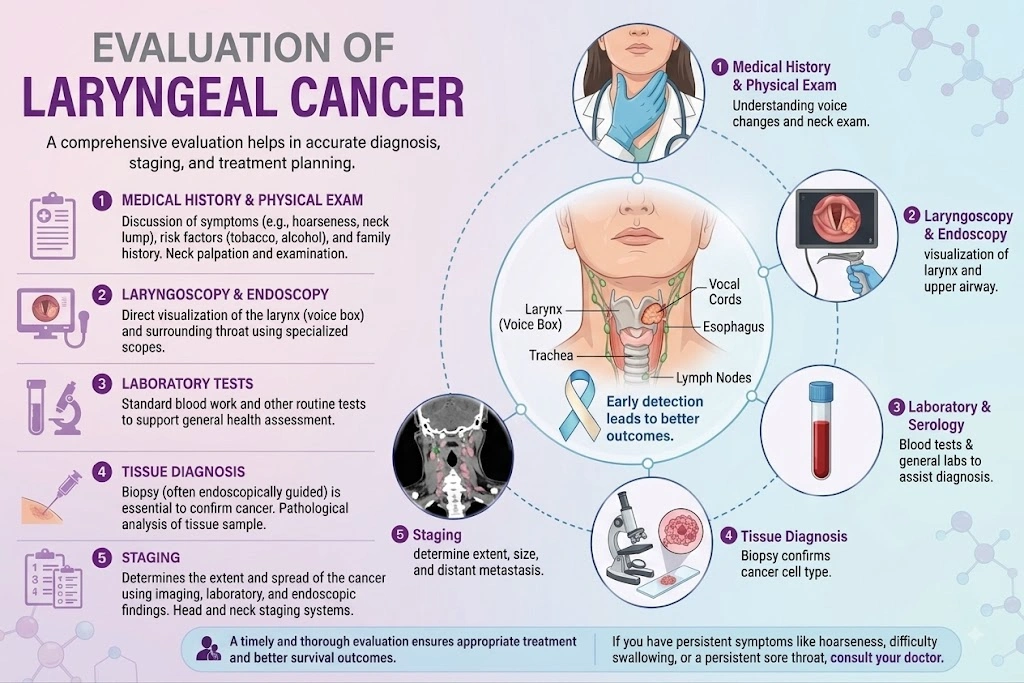
When laryngeal cancer is suspected based on symptoms and clinical examination, a detailed examination of the throat and larynx is carried out. The vocal cords and other areas of the larynx are carefully assessed for any abnormal growth.
Laryngoscopy is usually performed to directly examine the larynx. If an abnormal area is identified, a biopsy is performed to confirm the diagnosis and determine the type of cancer.
Once the diagnosis of laryngeal cancer is confirmed, imaging such as CT scan or MRI may be performed to assess the extent of the tumour. PET-CT may be recommended in selected patients to evaluate the spread of the disease.
Treatment Options for Laryngeal Cancer
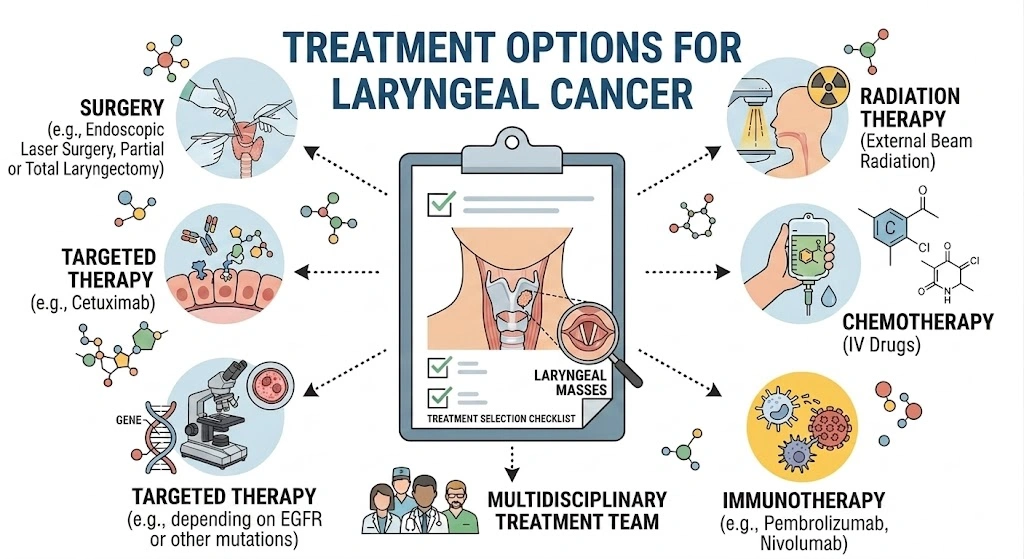
Management of laryngeal cancer usually involves a combination of treatment modalities. The right combination and sequencing of treatments is determined by a team of experts based on the stage, location and characteristics of the tumour.
Surgery
Surgery for laryngeal cancer involves removal of the tumour while preserving as much of the normal laryngeal function as safely possible. Depending on the location and extent of the tumour, procedures may include removal of part of the larynx or complete removal of the larynx. Nearby lymph nodes in the neck may also need to be removed depending on the stage of the disease.
Chemotherapy
Chemotherapy uses anti-cancer medicines to destroy or control the growth of cancer cells. It may be given along with radiation therapy or used in selected patients based on the stage and extent of laryngeal cancer.
Radiation Therapy
Radiation therapy uses high-energy rays to target and destroy cancer cells. It may be used as the primary treatment for selected early-stage cancers or combined with chemotherapy for more advanced disease.
Immunotherapy
Immunotherapy helps the body’s immune system recognize and attack cancer cells. Depending on the stage and characteristics of the tumour, immunotherapy may be considered for selected patients with recurrent or advanced laryngeal cancer.
Targeted Therapy
Targeted therapy includes drugs that act on specific factors involved in the growth and survival of cancer cells. They may be used in selected patients with advanced laryngeal cancer, usually based on the individual disease characteristics and treatment plan.
Supportive Care

Nutritional support
An important component of laryngeal cancer treatment is nutritional support. Patients may experience difficulty swallowing or eating due to the tumour or treatment. Appropriate nutritional supplementation and dietary guidance can help maintain adequate nutrition during treatment and support recovery.
Physiotherapy
Physiotherapy helps prepare patients for surgery, supports recovery after surgery and helps patients return to their previous activities of daily living. Rehabilitation may include exercises for the neck and shoulder, particularly after neck dissection. Speech and swallowing therapy may also play an important role in recovery.
Surgical Approaches for Laryngeal Cancer
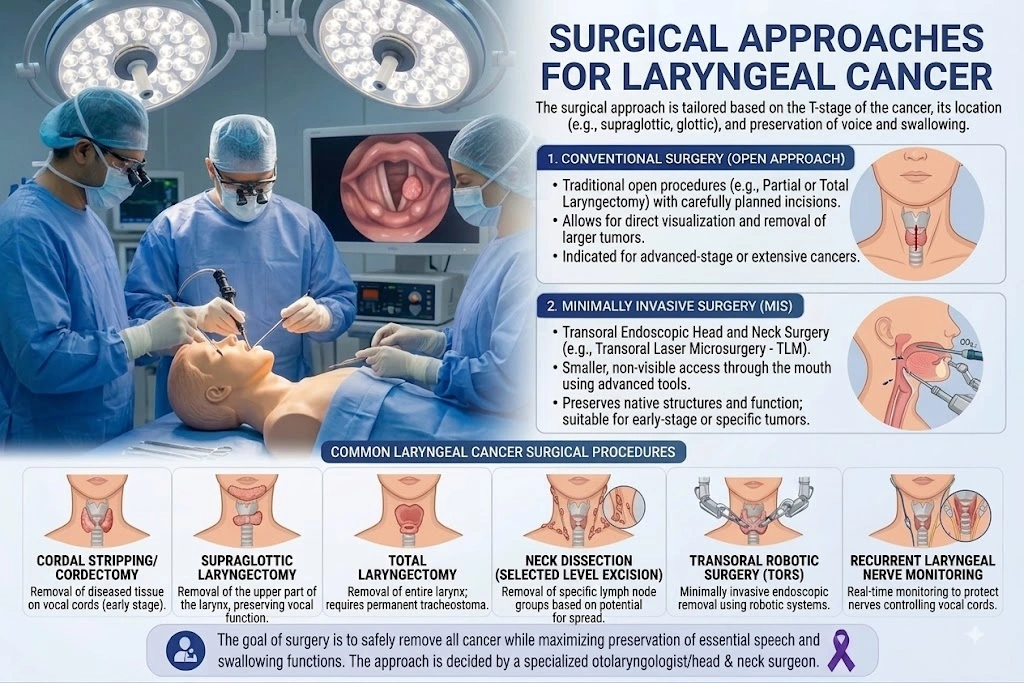
The choice of surgical approach depends on the stage of the cancer, tumour location, involvement of the vocal cords and surrounding structures, and the patient’s overall health.
Depending on the individual case, endoscopic surgery, partial laryngectomy, total laryngectomy or neck dissection may be recommended.
Each technique offers distinct advantages and is selected based on factors such as:
- The location of the tumour within the larynx
- The extent or stage of the cancer
- Involvement of the vocal cords and nearby structures
- The patient’s ability to preserve speech and swallowing functions
- Spread to the lymph nodes
- Response to previous treatments, if any
- The patient’s overall health and fitness for surgery
Every treatment plan is carefully tailored to ensure the safest and most effective outcome.
Dr. Ajay Simha is experienced in the surgical management of laryngeal cancers using appropriate surgical techniques based on the individual patient’s condition. The goal is always to achieve complete cancer removal while ensuring patient safety, surgical precision, preservation of important functions whenever possible and optimal recovery.
Frequently Asked Questions
Surgery is usually recommended when the tumour can be safely removed, depending on its location, stage and overall health.
Treatment options may include surgery, radiation therapy, chemotherapy, targeted therapy, immunotherapy or a combination of these.
Selected laryngeal cancers may be treated using endoscopic techniques, depending on tumour location, size, stage and individual patient factors.
Recovery varies depending on the type of surgery. Speech, swallowing and physical rehabilitation may support a gradual return to daily activities.
Dr. Ajay Simha provides personalized evaluation, advanced surgical expertise and comprehensive treatment planning for patients with laryngeal cancer.