
- Home
- About Doctor
- Cancer Surgery
- Procedures & Techniques
- Minimally Invasive Cancer Surgery
- Robotic Cancer Surgery
- Laparoscopic Cancer Surgery
- Thoracoscopic Cancer Surgery (VATS)
- Open (Conventional) Cancer Surgery
- Sentinel Lymph Node Biopsy (SLNB)
- Cytoreductive Surgery (CRS)
- Hyperthermic Intraperitoneal Chemotherapy (HIPEC)
- Scarless/ Remote Access Thyroidectomy
- Resources
- Contact Us
Rectal Cancer Surgery
Message from Dr. Ajay Simha

A diagnosis of rectal cancer can be difficult for patients and their families, often raising concerns about treatment options, surgery, recovery, and long-term outcomes.
When rectal cancer is suspected or confirmed, a detailed assessment is performed to understand the tumour’s location, extent, stage, and biological characteristics. The patient’s overall health and treatment goals are also considered before developing an individualized treatment plan.
I am Dr. Ajay Simha, Consultant Surgical Oncologist (Cancer Surgeon), and this page provides an overview of rectal cancer, including its symptoms, evaluation, treatment options, and surgical approaches.
What Is Rectal Cancer?
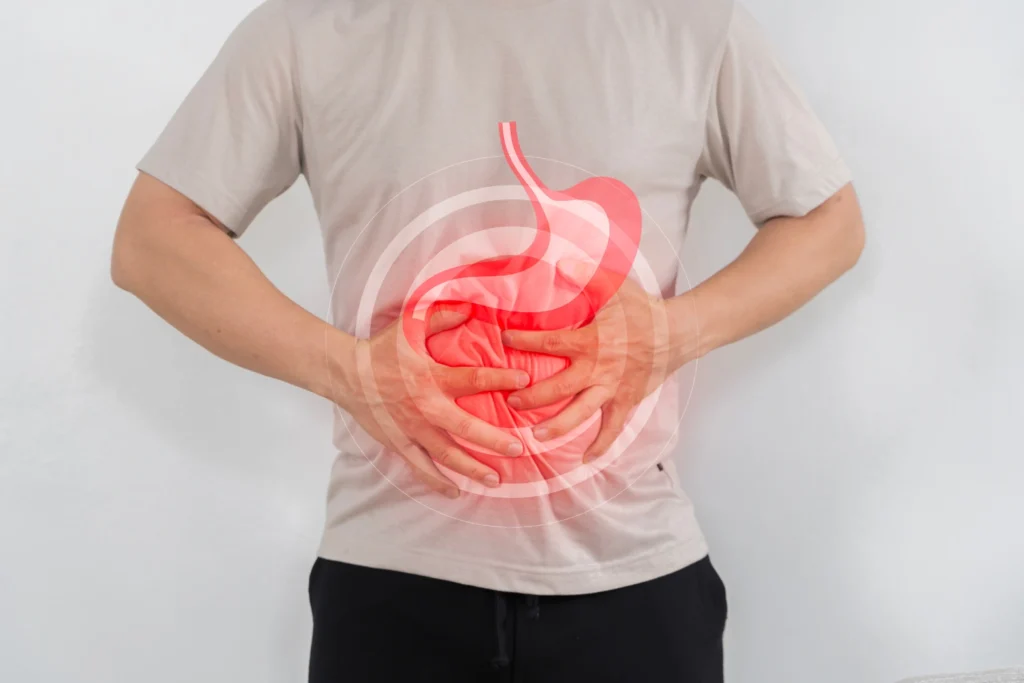
The rectum forms the lower portion of the large intestine and serves as a temporary storage area for stool before it is passed out of the body. Rectal cancer occurs when cells lining the rectum develop abnormal changes and begin multiplying in an uncontrolled manner, resulting in a tumour.
Symptoms of Rectal Cancer
Rectal cancer can produce symptoms related to changes in bowel function or bleeding. The nature and severity of symptoms may depend on the location and extent of the tumour.
Common symptoms include:
- Blood in stools
- Changes in bowel habits
- Persistent constipation or diarrhoea
- A feeling of incomplete bowel emptying
- Narrow or altered stool shape
- Rectal pain or discomfort
- Unexplained weight loss
- Persistent tiredness or weakness
Symptoms that persist or progressively worsen should be evaluated by a specialist to determine the underlying cause and enable appropriate treatment when necessary.
Evaluation of Rectal Cancer
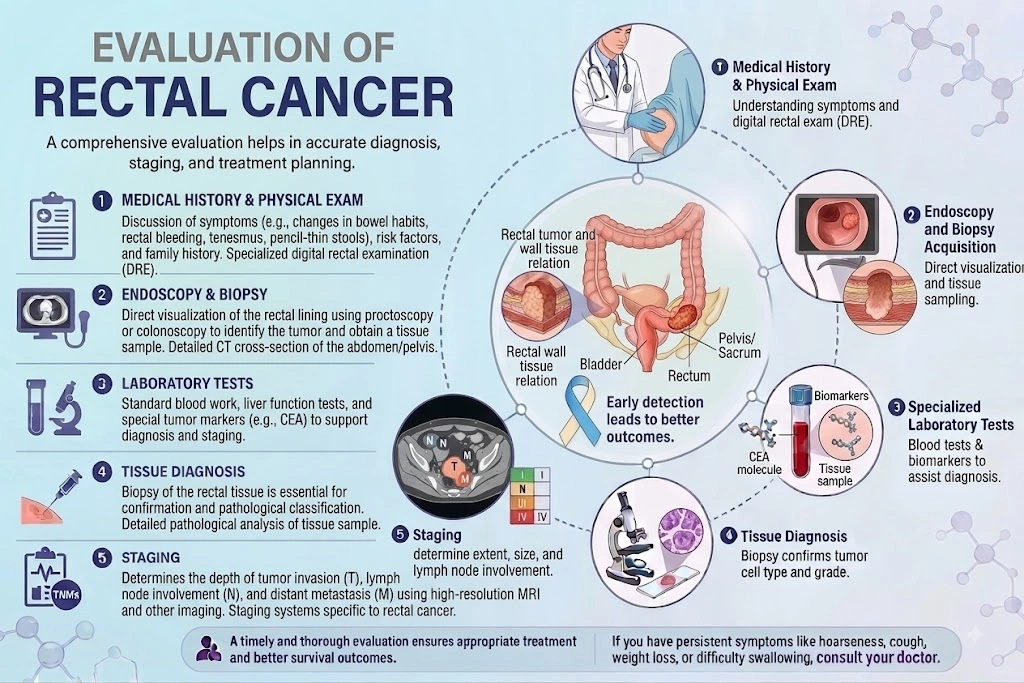
A thorough evaluation is essential to confirm rectal cancer, assess the extent of the tumour, and determine its stage.
Colonoscopy allows the rectum and colon to be examined directly, and a biopsy can be obtained from any suspicious area to establish the diagnosis.
Imaging plays an important role in assessing the local extent of rectal cancer. Depending on the clinical situation, investigations such as MRI, CT scans, or PET scans may be recommended. Blood tests and tumour marker assessment may also form part of the evaluation.
Treatment Options for Rectal Cancer
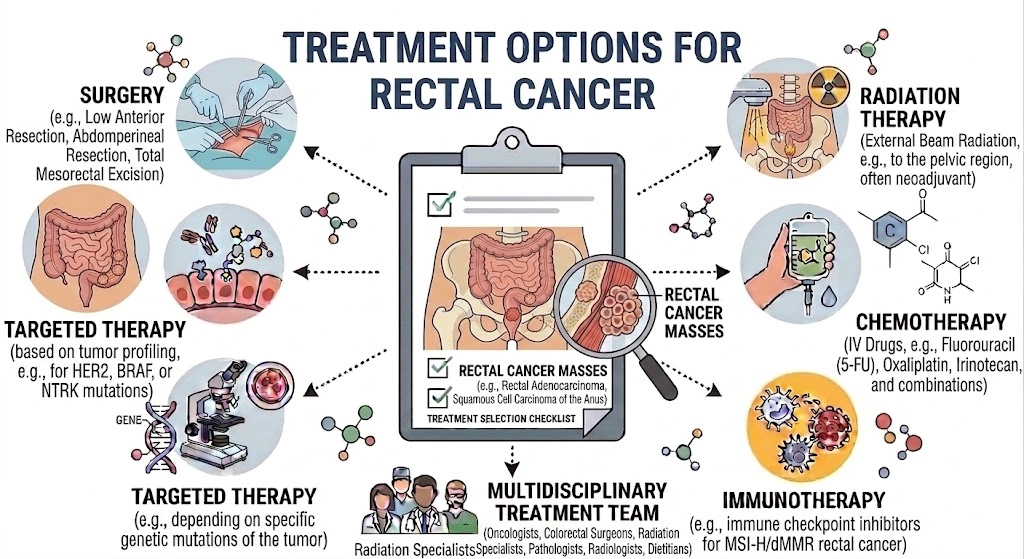
Treatment for rectal cancer is individualized according to the stage of disease, tumour location, extent of spread, and the patient’s overall health. Management may involve a combination of local and systemic treatments, with the sequence determined by a multidisciplinary team.
Surgery
Surgery plays a central role in the treatment of rectal cancer when the tumour can be removed safely. The procedure involves removing the cancer along with surrounding tissues and nearby lymph nodes as required. The extent of surgery depends on the tumour’s location and stage. Whenever safely possible, the surgical plan aims to achieve complete cancer removal while preserving normal bowel function and supporting quality of life.
Radiotherapy
Radiation therapy uses high-energy radiation to destroy cancer cells. It has an important role in selected rectal cancer patients and may be given before surgery to reduce the size or extent of the tumour and improve the chances of complete removal. In certain situations, radiation therapy may also be considered after surgery depending on the tumour characteristics and previous treatment.
Chemotherapy
Chemotherapy uses anti-cancer medicines to destroy cancer cells or prevent them from multiplying. Depending on the stage and characteristics of rectal cancer, chemotherapy may be administered before surgery, after surgery, or in combination with radiation therapy. The treatment schedule is determined according to the patient’s individual disease characteristics and overall treatment plan.
Targeted Therapy
Targeted therapy uses medicines that act on specific molecular features involved in the growth or spread of cancer cells. It may be considered for selected patients when tumour testing identifies characteristics that could make the cancer responsive to a particular targeted treatment. The use of these medicines is individualized based on the patient’s disease and treatment requirements.
Immunotherapy
Immunotherapy helps activate the body’s immune system to recognise and attack cancer cells. It may be appropriate for selected patients whose tumours have specific molecular or biological characteristics. Testing of the tumour can help determine whether immunotherapy may have a role in the overall treatment plan.
Supportive Care

Nutritional Support
Adequate nutrition is an important part of rectal cancer treatment and recovery. Cancer treatment can affect appetite, bowel function, nutritional status, and physical strength. Individualized nutritional guidance can help patients maintain adequate nourishment and support their recovery during different stages of treatment.
Physiotherapy
Physiotherapy can help patients improve their physical fitness before treatment and regain strength following surgery. It supports mobility, recovery, and a gradual return to regular daily activities.
Surgical Approaches for Rectal Cancer
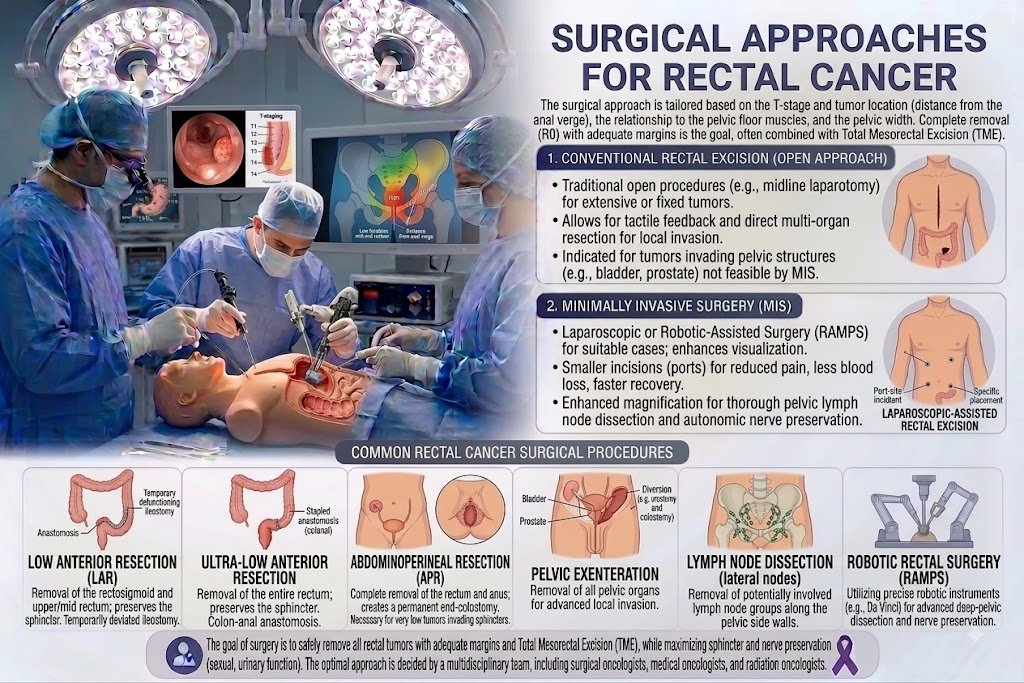
The choice of surgical technique depends on the tumour’s location and extent, cancer stage, the patient’s overall health, and the objective of preserving normal bowel function wherever possible.
For suitable patients, minimally invasive techniques such as laparoscopic or robotic-assisted surgery may be considered. These approaches can reduce surgical trauma and may support postoperative recovery.
Open surgery may be recommended in complex cases where it provides better access to the tumour or is required to achieve safe and complete cancer removal.
The surgical plan is based on factors such as:
- The exact location of the tumour within the rectum
- The size, depth, and stage of the cancer
- Involvement of nearby lymph nodes or surrounding structures
- Response to chemotherapy or radiation therapy, when given
- The patient’s overall health and fitness for surgery
The primary objective is to achieve complete cancer removal while preserving bowel function and quality of life wherever it is safely possible.
Dr. Ajay Simha is experienced in advanced rectal cancer surgery using minimally invasive as well as open surgical techniques. His approach emphasizes precise surgical planning, effective cancer control, patient safety, and supporting recovery throughout the treatment journey.
Frequently Asked Questions
Common symptoms may include blood in stools, changes in bowel habits, rectal discomfort, unexplained weight loss, and a feeling of incomplete bowel emptying. Early medical evaluation can help with timely diagnosis.
Rectal cancer diagnosis may involve colonoscopy, biopsy, imaging tests, and other investigations to understand the location and stage of cancer.
The type of surgery depends on tumour location, cancer stage, spread of disease, and the patient’s overall health. The goal is to remove cancer effectively while preserving bowel function whenever possible.
Treatment depends on the stage and characteristics of the cancer. While surgery is an important treatment option for many patients, chemotherapy, radiation therapy, or other treatments may also be recommended based on individual needs.
Rectal cancer surgery involves removing the cancerous portion of the rectum along with nearby tissues and lymph nodes when required. The procedure depends on the tumour location and treatment plan.